Real-World Weight Outcomes With Tirzepatide and Semaglutide in an Integrated Obesity Care Program
- Enara Health , San Mateo, CA, USA
Background
Pivotal trials of GLP-1 receptor agonists (GLP-1 RAs) report 12-month weight reductions of 14–21%, but real-world outcomes typically fall well below trial efficacy. Whether comprehensive multidisciplinary obesity care can deliver outcomes approaching trial efficacy, and how outcomes vary by agent, timing of initiation, and engagement, remains poorly characterized in U.S. clinical practice.
Methods
We performed a retrospective cohort study of 1,086 adults with obesity who initiated tirzepatide or semaglutide as their dominant GLP-1–based therapy between January 2023 and October 2024 within an integrated obesity care program including obesity medicine, dietitian counseling, exercise physiology, behavioral health, remote monitoring, and longitudinal clinical follow-up. Patients were grouped by timing of GLP-1 initiation relative to program enrollment: early initiation, defined as ≤60 days, or delayed initiation, defined as >60 days. The primary outcome was percent total body weight loss at 12 months from program baseline. Per-protocol analyses included patients with a fresh 12-month weight; intent-to-treat last-observation-carried-forward analyses included all initiators. Engagement was measured as attended visit count during months 0–12 and analyzed by tertile. Persistence was defined as proportion of days covered ≥80%. Durability was assessed at 18 months.
Results
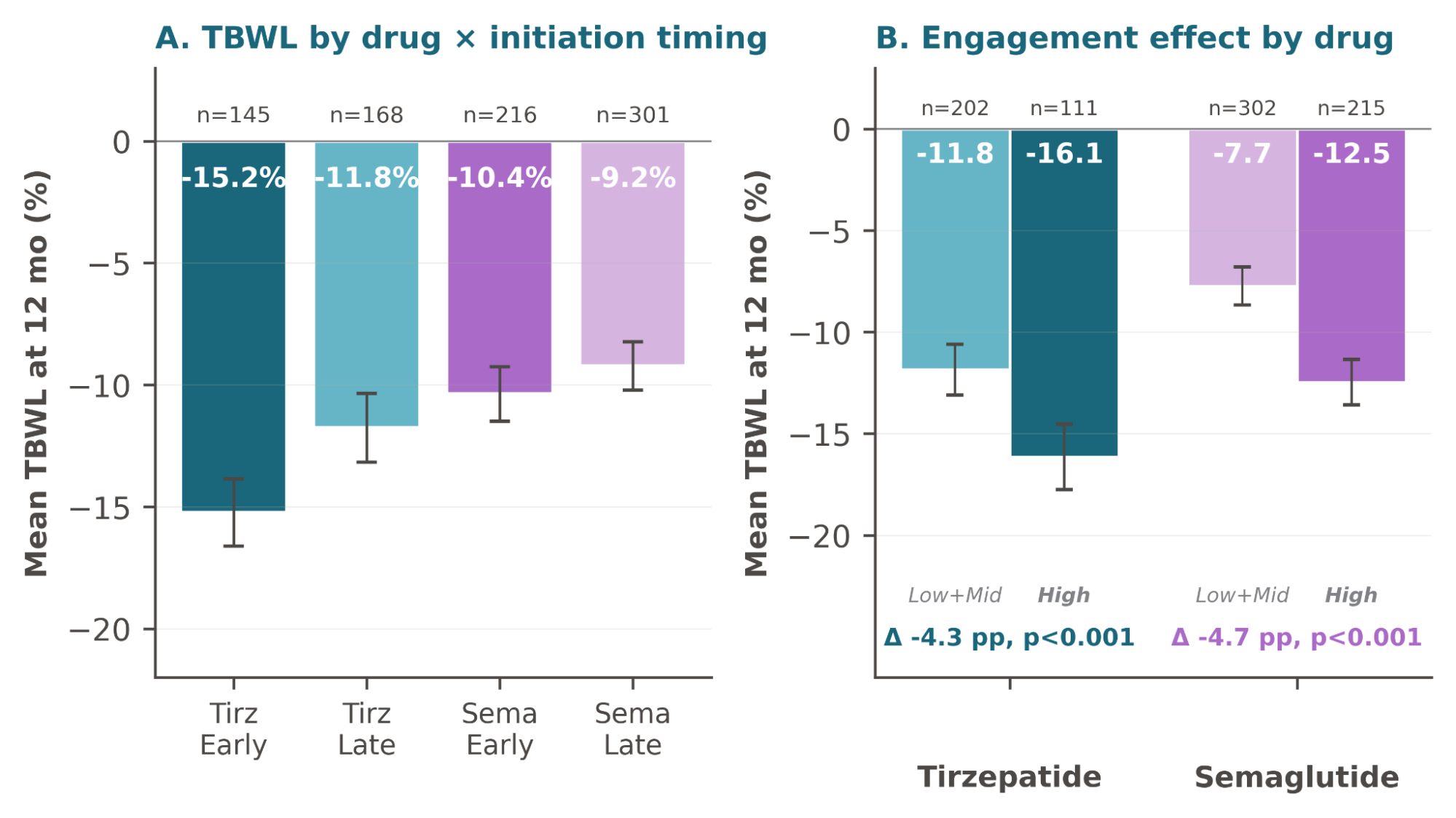
Mean baseline age 47.5 years (SD 12.8); 80% women; mean BMI 37.5 kg/m². At 12 months PP (n=830), early-initiation tirzepatide (n=145) achieved −15.2% mean TBWL (95% CI −16.6, −13.9), with 53% achieving ≥15% and 27% achieving ≥20%. Early-initiation semaglutide (n=216) achieved −10.4% TBWL (−11.5, −9.3). Tirzepatide outperformed semaglutide among early initiators by 4.9 pp (p<0.001). Delayed initiation attenuated tirzepatide outcomes (−11.8% vs −15.2%; p<0.001) but not semaglutide (−9.2% vs −10.4%; p=0.13). High engagement (top visit tertile) was associated with additional weight loss for both agents (tirzepatide Δ −4.3 pp; semaglutide Δ −4.7 pp; both p<0.001), with the largest engagement effect in subgroups with otherwise lower outcomes (delayed tirzepatide Δ −5.4 pp; early semaglutide Δ −6.5 pp). Persistence was high (87% tirzepatide, 95% semaglutide). Outcomes were durable at 18 months (early tirzepatide −16.5%; early semaglutide −11.6%). ITT-LOCF preserved all contrasts.
Discussion
Pivotal GLP-1 RA trials report 12-month weight reductions of 14–21%, but real-world outcomes routinely fall short of trial efficacy. How outcomes vary by agent, timing of initiation, and patient engagement remains poorly characterized in U.S. clinical practice. Real-world GLP-1 effectiveness depends on the care infrastructure that keeps patients engaged, not medication selection alone — engagement is a modifiable, agent-independent lever.
Conclusion
In an integrated real-world obesity care model, GLP-1 outcomes were shaped not only by medication selection but by the care system surrounding pharmacotherapy. Tirzepatide produced greater weight loss than semaglutide, particularly when started early, but visit engagement was the most consistent agent-independent driver of response. High engagement was associated with approximately 4–5 additional percentage points of TBWL and appeared most valuable in subgroups with weaker medication-timing profiles. These findings suggest that real-world GLP-1 effectiveness depends on building the clinical infrastructure that keeps patients connected to care. Delaying GLP-1 initiation did not improve outcomes.